Downed Pilot Rescues
What happens when a pilot goes down in hostile territory — and the books that explain it
When a pilot goes down in hostile territory, everything changes. Combat Search and Rescue is one of the most dangerous missions in modern warfare — combining speed, coordination, and enormous risk as rescue forces launch into contested airspace to retrieve a single aircrew member. From Vietnam to the Balkans to Afghanistan, the books that chronicle CSAR reveal some of the most selfless and tactically complex operations in American military history.
By War & Fiction · Editorial standards and corrections
When the Pilot Goes Down
Combat Search and Rescue begins the moment an aircraft goes down in hostile territory. The survival radio activates. The AWACS overhead logs the event. And somewhere — on an airbase, on a carrier, on a forward operating base — a rescue force begins to move.
What happens next depends on where, when, and how bad the threat is. In a permissive environment, a helicopter can lift within minutes. In a non-permissive environment — where enemy forces are already moving toward the crash site — the calculus gets dramatically harder. The rescue force may need fighter escort. It may need ground forces. It may need to wait for darkness. And every minute it waits, the downed pilot is evading, hiding, and using up the limited battery life on the survival radio that is the only thread connecting him to the people trying to reach him.
What Pilots Are Trained to Do
The survival, evasion, resistance, and escape training that American military aviators receive is built around one core assumption: help is coming, but it may take time. Pilots are trained to move away from the crash site immediately, to establish a pattern of communication that doesn't give away their position to enemy direction-finding equipment, and to avoid capture as long as possible because the moment they're captured, the rescue mission becomes a hostage negotiation.
The evasion tradecraft is detailed and counterintuitive. Move at night. Rest in concealment during daylight. Leave no sign. Use water sources that are off the obvious routes. Keep the radio off except during scheduled communication windows. The goal is to stay alive and free long enough for the rescue force to reach you — and that might mean days, not hours.
The Rescue Force
Air Force Pararescuemen — PJs — are the primary recovery force for downed aircrew in the American military. They are trained as both special operations combatants and emergency medical technicians, capable of parachuting, swimming, or rappelling into a recovery zone, stabilizing a casualty, and fighting their way out if necessary. The training pipeline to become a PJ is among the longest and most demanding in the U.S. military — roughly two years from selection to qualification.
The helicopter assets that carry them — in modern operations, primarily the HH-60G Pave Hawk — are equipped with terrain-following radar, forward-looking infrared, and aerial refuelling capability that allows them to fly at low level in complete darkness for extended periods. The crews that fly these aircraft train specifically for the CSAR mission. Like the Night Stalkers of the 160th SOAR, their entire professional focus is the kind of mission nobody wants to need but everyone wants to know exists.
The Iran Context
Any military operation that involves aircraft over Iran introduces the CSAR problem immediately. Iran operates a layered air defence system that has been continuously improved for decades. Downed aircrew in Iranian territory would face a government with strong motivation to capture rather than allow rescue, and a population and terrain that makes evasion extremely difficult. The rescue problem in an Iranian scenario is categorically harder than Afghanistan or Iraq — more like the Vietnam scenarios that built the CSAR doctrine in the first place.
The history of those Vietnam rescues — BAT-21 in particular — is directly relevant. Lt. Col. Iceal Hambleton evaded for eleven days in 1972, and the rescue effort to reach him cost six more aircraft and eleven more lives. The cost-benefit calculus of CSAR is always brutal: how many people do you risk to recover one? The American answer, institutionalised as doctrine, is that you go — but you go smart, and you go prepared for the fight.
The Books
The literature on CSAR is smaller than it should be, given how central the mission is to how American airpower operates. BAT-21 is the essential starting point — the Vietnam rescue that defined the modern doctrine. None Braver is the best contemporary account of what PJs actually do. Scott O'Grady's Return with Honor is the first-person pilot's view: shot down over Bosnia, six days evading in hostile terrain, and the helicopter that finally came. Alone at Dawn closes it with Takur Ghar — when the rescuers themselves needed rescuing. Together they span the full arc of what CSAR costs and what it means.
READ NEXT — BOOKS ON THIS OPERATION
Amazon and Audible links are provided for convenience; we do not earn commissions from these purchases.

BAT-21
William C. Anderson
The definitive CSAR narrative — Lt. Col. Iceal Hambleton evades for eleven days in Vietnam while rescuers risk everything to reach him. The story that defined how America thinks about combat rescue.
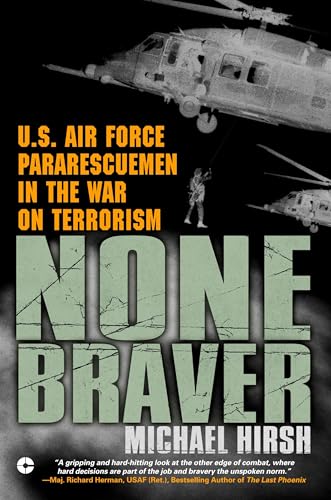
None Braver
Michael Hirsh
Embedded with Air Force Pararescue teams in Afghanistan — the fullest account of what PJs actually do and how CSAR works in a modern war zone.

Return with Honor
Scott O'Grady
O'Grady's F-16 was shot down over Bosnia in June 1995. He evaded for six days in hostile territory before a Marine helicopter extraction — the textbook case of SERE training and CSAR doctrine working exactly as designed.
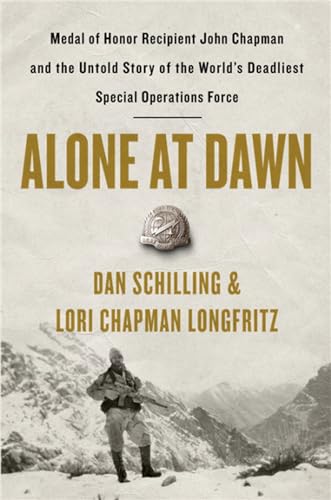
Alone at Dawn
Dan Schilling & Lori Longfreau
The story of Air Force Combat Controller John Chapman and the Battle of Takur Ghar — the Medal of Honor action that defines the modern CSAR and special operations culture of leaving no one behind.