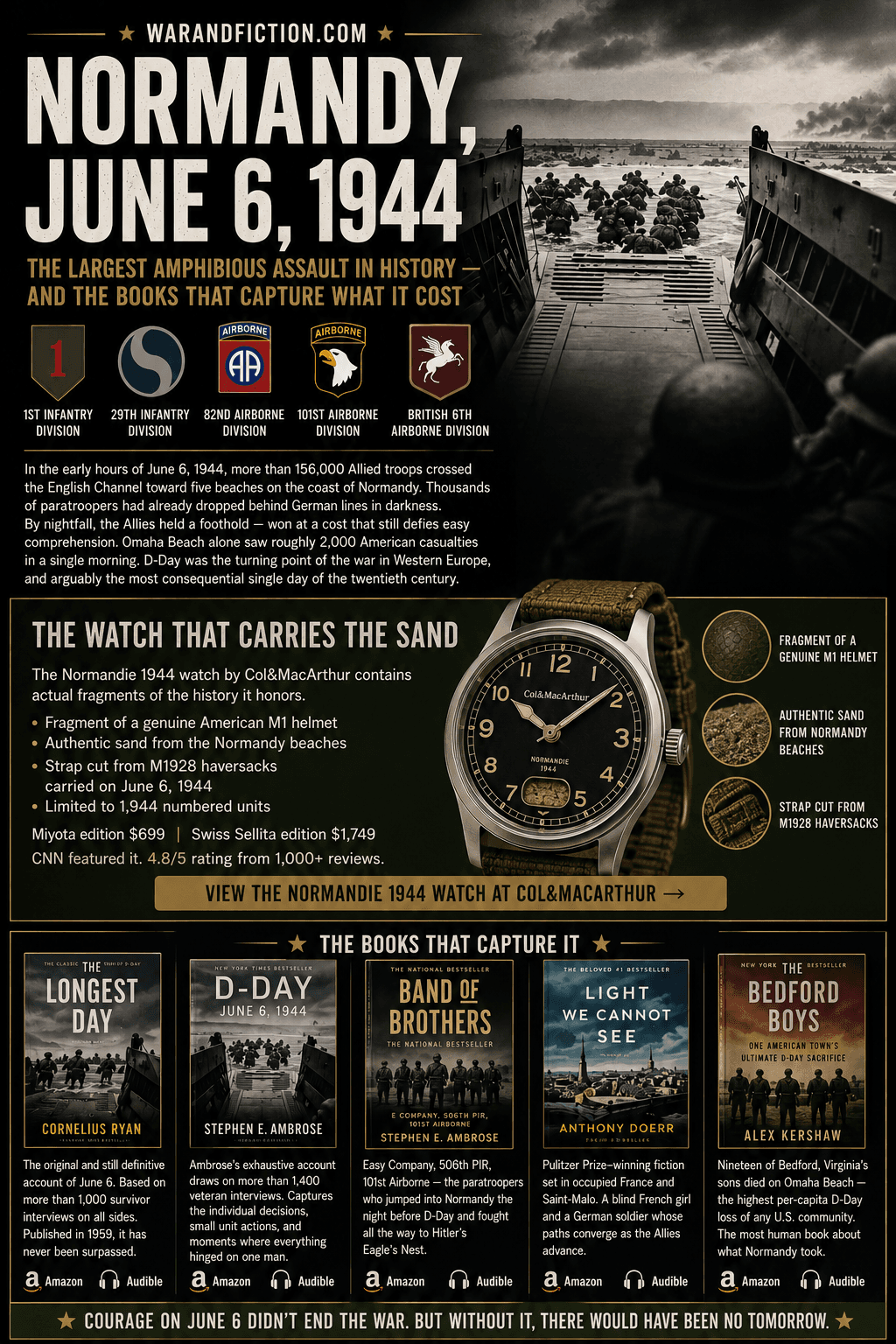
Most military-inspired watches use history as branding. The Normandie 1944 by Col&MacArthur does something far stranger. It physically contains it.
The Belgian watchmaker built the Normandie 1944 around one idea: if a watch is going to commemorate D-Day, it should carry an actual connection to the men who crossed those beaches. So they sourced fragments of genuine American M1 helmets used during the liberation of Europe. The dial texture incorporates that steel. The small capsule embedded in the watch contains authentic sand from the Normandy beaches themselves. Even the strap material traces back to M1928 haversacks — the field packs American troops carried ashore on June 6, 1944.
It sounds like marketing fiction. It isn't. And that is what makes the watch fascinating.
Normandy Wasn't Aesthetic
Most World War II branding today smooths the edges off history. Normandy wasn't cinematic while it was happening. It was confusion, machine-gun fire, seasickness, drowning men, landing craft pinned in the surf, and small groups of exhausted infantry trying to claw their way off beaches under direct fire.
Omaha Beach alone saw roughly 2,000 American casualties in a single morning.
The airborne drops were chaos. Men landed in flooded fields, church steeples, hedgerows, and tree lines miles from their objectives. Some drowned before firing a shot.
The scale of D-Day is difficult to comprehend now because it exists in public memory as a historical certainty. But on the morning of June 6, 1944, nobody involved knew if the invasion would succeed.
That tension is what the Normandie 1944 is trying to preserve. Not triumph. Weight.
A Watch Built Like an Artifact
The Normandie 1944 doesn't feel designed like a modern luxury watch. It feels designed like something recovered. The dial is intentionally subdued and utilitarian. The muted military tones avoid the polished "heritage" aesthetic most WWII-inspired watches fall into. The strap material matters because it isn't merely styled after military canvas — it directly references the equipment American soldiers carried onto the beaches.
The most striking element is the capsule of Normandy sand set into the watch itself. That detail sounds gimmicky until you realise what it represents.
The beaches at Normandy are not abstract historical ground. They are effectively a military cemetery without headstones. The watch isn't carrying decorative sand. It's carrying the shoreline where thousands of men died. That changes how you look at it.
Why Military History Collectors Care About Objects
Military history has always been partly about artifacts. Helmets. Dog tags. Field jackets. Maps. Watches. Not because the objects themselves matter more than the people — but because objects make history physical.
The M1 helmet fragment inside the Normandie 1944 matters because somewhere, decades ago, that helmet belonged to a man crossing Europe under fire. Maybe Normandy. Maybe Market Garden. Maybe the Bulge. Nobody can know. But the object survived.
And now part of it continues moving through time attached to somebody else's wrist. That's a strangely human idea.
The Growing World of Military-Inspired Watches
The military watch world has exploded over the last decade. Tudor built an entire identity around special operations and military-issued dive watches. Hamilton leans heavily into aviation and field history. Marathon still produces watches for military contracts. CWC remains tied to British military culture.
But Col&MacArthur went somewhere different. Instead of building a watch inspired by military history, they attempted to build one physically connected to it. That makes the Normandie 1944 feel less like a commemorative watch and more like a historical relic adapted into modern form.
The Price of Memory
The Normandie 1944 is limited to 1,944 numbered units. The Miyota automatic version sits around $699. The Swiss Sellita version pushes closer to $1,749. That places it in an unusual category — too expensive to be an impulse-buy military novelty, too historically unusual to compete directly with mainstream luxury watches.
Which is probably why the people who love it seem to really love it. You're not buying it because it's the best technical watch in the world. You're buying it because the object itself tells a story. And increasingly, that's what modern collectors want.
The Normandie 1944 works because it understands something most military products don't. History is not branding. It is memory. And memory carries weight.
Especially when it comes from a beach where thousands of men stepped off landing craft into machine-gun fire so the modern world could exist at all.
Some watches tell time. This one carries it.