Old Man's War Reading Order
John Scalzi's complete military sci-fi universe — and why it became the defining series of the 2000s
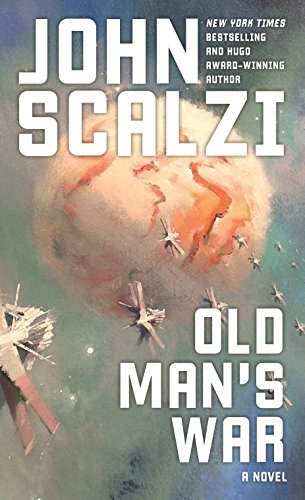
Old Man's War launched in 2005 and changed what mainstream military science fiction looked like. Scalzi's premise — that humanity recruits only senior citizens for interstellar warfare, transplanting their consciousness into young supersoldier bodies — was provocative, funny, philosophically sharp, and driven by some of the most readable prose in the genre. The series grew to six novels and two story collections, built a fully realized universe, and created a readership that became the gateway for millions into military sci-fi.
John Scalzi had a blog before he had a publisher. Old Man's War was posted chapter-by-chapter on Whatever, his personal site, before Tor picked it up in 2005. This matters because it explains something about the book's tone: it was written to be read immediately, in installments, by people who had to want to come back. Scalzi learned to write propulsively before he learned to write for the long shelf. The result is a military science fiction novel that moves at a pace unusual for the genre — and that made it the most accessible entry point into military sci-fi for a generation of readers who hadn't found their way in through Heinlein or Haldeman.
The Premise and Why It Works
Earth maintains a Colonial Defense Forces that humanity knows almost nothing about. Citizens are told the CDF defends the colonies scattered across the galaxy. They are not told how the CDF fights, what it fights, or what enlisting actually means. The only disclosed fact is the recruitment policy: the CDF only accepts volunteers aged 75 and older. You sign up at retirement age and ship out at 75. Everything else is classified until you're already committed.
John Perry, freshly widowed at 75, enlists. He discovers that enlisting means his consciousness will be transferred into a new body — a young, enhanced, genetically engineered supersoldier body designed specifically for the kind of warfare the CDF actually conducts. His old body is left behind in an incinerator. He wakes up looking 20, physically capable of things impossible in his original form, and surrounded by other septuagenarians who are having the same experience.
The genius of this premise is that it sidesteps the standard military sci-fi problem of the inexperienced protagonist who has to learn everything about warfare from scratch. Perry and his cohort have 75 years of life experience, judgment, and perspective. They understand loss, consequence, and the weight of decisions. They're not recruits learning what danger is — they're people who've been around long enough to know exactly how much they have to lose, placed into bodies built for combat and handed weapons that can end civilizations. The wisdom-in-a-young-body framework lets Scalzi have both: the tactical pace of a young soldier's story and the moral weight of someone who's actually thought about what war costs.
The Complete Reading Order
The Old Man's War universe spans six novels, two story collections, and a short fiction piece that serves as a bridge between eras. Reading order matters more than publication order here because several books overlap in timeline.
Old Man's War (2005) — Start here, always. Perry's enlistment, training, and first combat deployments. The universe is established from the ground level. Scalzi deliberately withholds the big picture, letting Perry's limited perspective carry the reader through the same gradual revelation Perry experiences.
The Ghost Brigades (2006) — Shifts focus to the Special Forces — the CDF's more elite, more disturbing contingent, built from the DNA of people who died before they could serve. A scientist has defected to the alien side, and the Special Forces are sent to understand why. Darker than Old Man's War, and the book where the moral complexity of the CDF's methods comes fully into focus.
The Last Colony (2007) — Perry and his wife Jane Sagan (from Ghost Brigades) are recruited to lead a new colony, which they gradually discover has been set up as a geopolitical gambit. The most political book in the series and the one that pulls the widest-angle view of the universe Scalzi has been building.
Zoe's Tale (2008) — A deliberate parallel novel: the same events as The Last Colony, told from the perspective of Perry and Jane's adopted daughter Zoe. This one divides readers. Scalzi structured it as YA-adjacent, which some find jarring after the three previous books. Read it, but know going in that it's intentionally different in register.
The Human Division (2013) — Originally published as serial episodes, this collects 13 interconnected stories following a diplomatic mission running parallel to the events of The Last Colony. It ends on a deliberate cliffhanger that The End of All Things resolves.
The End of All Things (2015) — Four novellas completing the story begun in The Human Division. The universe-level political situation comes to a resolution. This is a satisfying endpoint if you want closure, though Scalzi has left the universe open for future work.
Unlocked: An Oral History of Haden's Syndrome (2014) — A short piece that establishes background for the Lock In universe rather than the Old Man's War universe. Some readers encounter it as part of an omnibus; it's not part of the main continuity.
What Old Man's War Is Arguing With
Military science fiction has a complicated relationship with its predecessors. Every major work in the genre is partly a response to what came before it, and Old Man's War is no exception.
Heinlein's Starship Troopers (1959) established the genre's foundational premise: that military service is the highest expression of citizenship, that powered armour and interstellar warfare produce a new kind of warrior-citizen, and that the relationship between soldier and state is fundamentally honorable when the state takes its obligations seriously. Heinlein's protagonist, Juan Rico, is trained to believe this and ends up believing it sincerely. Starship Troopers is the optimistic version of military sci-fi: the system is brutal but functional, and the men who serve it emerge better for the experience.
Joe Haldeman's The Forever War (1974) was the Vietnam-era counter-argument. Haldeman served as a combat engineer in Vietnam and came back to write a novel about soldiers who return from interstellar warfare to find that Earth has changed beyond recognition while they were gone — relativity means that each tour ages the soldiers only months while decades pass at home. The war is endless, its objectives unclear, and the government that sends soldiers to die never explains why the fighting is necessary. The Forever War is the anti-Starship Troopers: the system is neither functional nor honorable, and the men who serve it survive mostly through luck and competence that the institution doesn't deserve.
Old Man's War sits between these positions. Scalzi's CDF is neither Heinlein's honorable institution nor Haldeman's corrupt machine. It's a bureaucracy doing the best it can in an impossibly hostile universe, making decisions that are defensible given what it knows and morally catastrophic given what it withholds. The CDF lies to its recruits by omission — not because it's evil, but because full disclosure would collapse the recruitment pipeline. Perry discovers this gradually and has to decide what to do with the knowledge. The moral weight of that decision, placed on a 75-year-old consciousness in a 20-year-old body, is where Old Man's War finds its depth.
Why It Became the Gateway Drug
Old Man's War hit at a specific moment. Military sci-fi in 2005 was well-established but not especially accessible. The Baen Books wing of the genre — David Weber's Honor Harrington, Eric Flint's 1632 — required substantial investment in dense world-building and were written for readers who already wanted to be there. The Scalzi approach was different: short sentences, a first-person narrator with a wry voice, jokes that land, and a pace that never lets the reader settle into boredom. It read more like Michael Crichton or Terry Pratchett than David Drake.
This accessibility created a new reader. People who would never have picked up Weber or Drake found Old Man's War through word-of-mouth and Amazon recommendations. Those readers then wanted more, and they didn't necessarily want more Scalzi — they wanted more military sci-fi that had the same quality. Which meant they eventually found their way to Haldeman, Heinlein, and the contemporary authors building on that tradition.
Galaxy's Edge by Jason Anspach and Nick Cole is the most direct contemporary inheritor of Old Man's War's accessibility paired with genuine military authenticity. Anspach and Cole write with the tactical specificity that Scalzi consciously avoids — Galaxy's Edge is written for people who want to know exactly how the Legion clears a room, what the command structure looks like from the squad level up, and why specific tactical decisions are made. It's the version of military sci-fi that appeals to readers who came in through Old Man's War and wanted the dial turned toward authenticity. Start with Legionnaire (Book 1) and read in publication order.
The Audiobook Question
Old Man's War on Audible is narrated by William Dufris, who brings exactly the right balance of wry humor and genuine gravity to Perry's voice. The audiobook is one of the cleaner sci-fi listening experiences available — Scalzi's prose translates well to audio because it's built on rhythm and pacing rather than visual imagery. If you're an audiobook listener working through the series, Dufris narrates the first four books, which creates a consistent experience through the main story arc.
What to Read After You Finish
If Old Man's War was your first military sci-fi and you want to go deeper into the genre's history: The Forever War is the obvious next stop, followed by Starship Troopers. The three books together form a complete picture of how the genre thinks about the relationship between soldiers and the institutions that deploy them. They disagree with each other, which is most of the point.
If you want more contemporary military sci-fi at a similar accessibility level but with harder military authenticity: Galaxy's Edge, starting from Book 1 (Legionnaire). Same galaxy-spanning scope, same interstellar military, but written by people with actual military service who care about getting the small operational details right. The humor is darker, the casualties are more consequential, and the moral framework is thornier. It's where Old Man's War readers go when they want the dial turned up on the military part.
If you want military sci-fi that takes the genre's premises to their most extreme logical conclusions: All You Need Is Kill by Hiroshi Sakurazaka (the novel that became the Tom Cruise film Edge of Tomorrow). A soldier trapped in a time loop repeating the same battle until he perfects it — military training taken to a philosophical extreme. Short, brutal, and genuinely original in a genre that sometimes recycles its best ideas too often.
Old Man's War works because Scalzi understood something that not every military sci-fi writer figures out: the most important thing isn't getting the hardware right or making the tactics credible. It's making the reader care about the person carrying the weapon. Perry is a real character because he has a life before the military, because his motivations for enlisting are private and human, and because the gap between what he expected and what he finds is where the story actually lives. The genre has never stopped benefiting from that lesson.
READ NEXT — BOOKS ON THIS OPERATION
Affiliate links — as an Amazon Associate we earn from qualifying purchases.
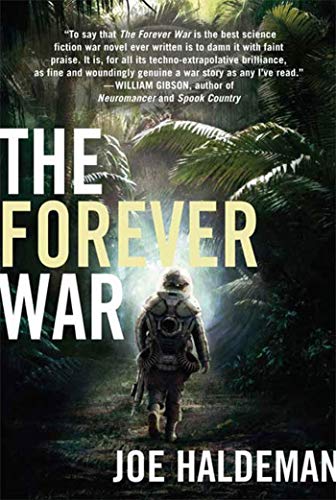
The Forever War
Joe Haldeman
The 1974 novel that Old Man's War is in direct conversation with. Haldeman wrote it as a Vietnam memoir in sci-fi form — the alienation of returning soldiers, the futility of unclear objectives, the government that sends men to die for reasons that never fully make sense. The two books form a natural pair.
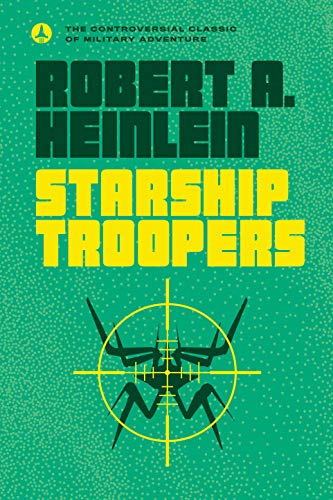
Starship Troopers
Robert A. Heinlein
The 1959 grandfather of all military sci-fi. Heinlein built the template Scalzi and Haldeman both borrowed and argued with — powered armour, an interstellar military, the citizen-soldier philosophy. Read this to understand what Old Man's War is responding to.
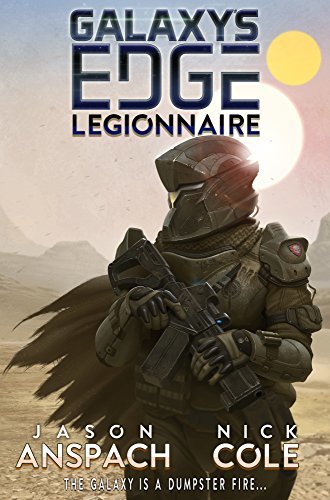
Legionnaire
Jason Anspach & Nick Cole
Book 1 of Galaxy's Edge — the contemporary equivalent of Old Man's War in terms of accessibility and scope, but written with the tactical authenticity of people who've actually been in the military. If Old Man's War showed you that military sci-fi could be funny and philosophically engaged, Galaxy's Edge shows you how grim and operationally precise it can get.