Reporting checked September 10, 2026. This is a developing story.
An underwater drone changes hands. Before anyone outside the operation can inspect it, the argument over its importance is already under way.
On September 8, Iran’s Revolutionary Guards said they had captured a U.S. uncrewed submersible near the entrance to the Strait of Hormuz. Iranian state media identified it as an Anduril Dive-LD. U.S. officials offered a different account: an older underwater drone had malfunctioned more than a day earlier while surveying regional waters, and it carried neither sensitive collected data nor classified sonar or radar equipment. Reuters could not independently verify Iran’s capture claims. Reuters reporting.
Those statements should remain attached to the people making them. Iran’s description does not establish an intelligence windfall. The American description is not an independent technical examination of the recovered vehicle either.
Reuters’ follow-up, updated September 10, reports that Navy officials described a malfunctioning Dive-LD subsequently recovered by Iranian forces. Its interviews point to a possible opportunity to study mechanical systems, rather than a demonstrated breakthrough. Analysts quoted in the report doubt that the loss will give Iran a decisive military advantage. Reuters’ updated assessment.
What kind of machine are we discussing?
This is an unmanned underwater vehicle, commonly called a UUV, rather than a UAV—the latter term refers to an aerial vehicle. Reuters identifies the Dive-LD as an autonomous undersea vehicle intended for long-duration missions. That description does not establish that this particular vehicle was armed or making its own targeting decisions. Autonomy in navigation and autonomy in the use of force are different questions. Platform context.
A photograph of a vehicle does not disclose its complete configuration. A platform’s possible missions are not a record of the task it was carrying out when it was lost.
Possession is not the same as replication
The analytical question is what access to an unfamiliar machine might reveal. At a broad level, there are several different possibilities: physical construction, installed equipment, accessible software, and any information remaining on the system. We do not know from the reporting reviewed here which, if any, would provide a meaningful advantage in this case.
Hudson Institute analyst Bryan Clark told Reuters that Iran could examine and replicate mechanical systems, while describing protections around the software. That is an expert assessment of possibilities; the report does not present a completed Iranian examination or proof that those protections have been defeated. Clark’s assessment.
Commercial availability and intelligence value are also different questions. Something does not have to be classified to be interesting to another country's engineers. Equally, seeing how one vehicle is assembled does not supply the entire manufacturing process, software ecosystem, testing history or operating knowledge behind it.
Think of the difference between having a tool and having the organisation that knows how to build, maintain and use it. Capturing the first does not automatically deliver the second.
This is a framework for asking questions, not a conclusion that Iran has recovered valuable secrets. The available evidence does not justify either a confident declaration of catastrophe or a confident claim that nothing could be learned.
Could China or Russia benefit?
It is a reasonable hypothetical question. If a state obtains useful technical knowledge, sharing that knowledge with another state could extend its value. But that chain has conditions: there must be useful information, it must be accessible, and a transfer must actually take place.
The reporting reviewed for this article does not establish that this vehicle, its software or findings from an examination have been transferred to China or Russia. A plausible scenario remains a scenario until there is evidence of a transfer.
The news story is about a lost vehicle, Iranian possession and disputed assessments of its importance. The larger question is how militaries weigh the benefits of deploying autonomous systems against the possibility of losing control of them.
Start with the nonfiction: Army of None
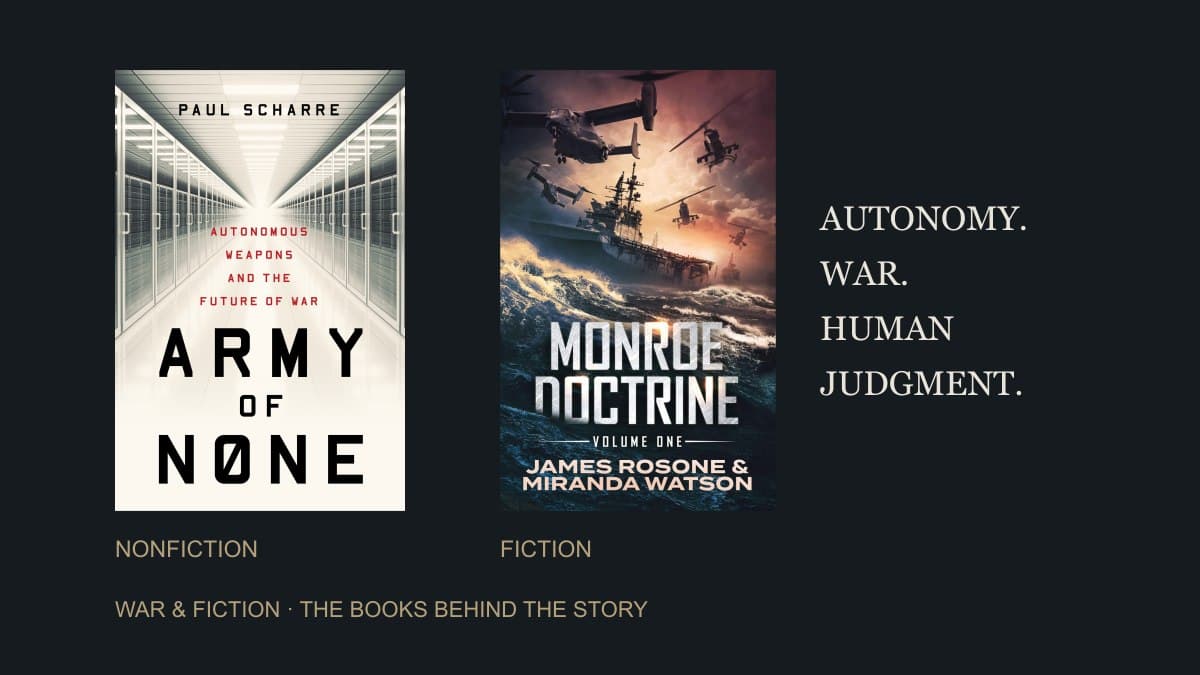
Paul Scharre's Army of None: Autonomous Weapons and the Future of War examines autonomy, military decision-making and the place of human judgment when machines take on more of war's work. It is a useful route into the subject because the central issue extends beyond whether a particular vehicle is clever or expensive. Scharre’s book overview.
Its relevance here is conceptual. It is not an investigation of this incident, nor evidence of what was installed on the lost drone. It gives the reader a broader set of questions to bring to the next autonomous-weapons headline.
Then follow the question into fiction
For a fictional exploration of AI and great-power conflict, our next stop is Monroe Doctrine by James Rosone and Miranda Watson. The series brings Chinese military AI into a war involving the Western powers; War & Fiction's guide introduces the Jade Dragon storyline and the books in order. Our Monroe Doctrine reading guide.
The connection is the fear of a technological advantage changing the pace and control of war. The novel's escalation is a fictional scenario, not a forecast we can attach to a recovered underwater vehicle.
Read Scharre for the questions around autonomy and human judgment. Read Rosone and Watson to explore a fictional conflict in which those questions become urgent. Keep the reporting, the analysis and the imagined future distinct.
The recovered machine may eventually tell a clearer story. For now, the useful habit is to ask what has been demonstrated, what an expert thinks is possible, and what belongs on the fiction shelf.